

Treatment of epiphora (excessive tearing).

Diagnosis of the causes of excessive tearing and treatment according to the condition to ensure eye comfort.

Prepare for healthy eyes free from excessive tearing using the latest medical techniques.

Dr. Ossama Abdel Hakim
Consultant of Ophthalmology and Eye Surgery.

Over 25 years of experience.

How do tears work?

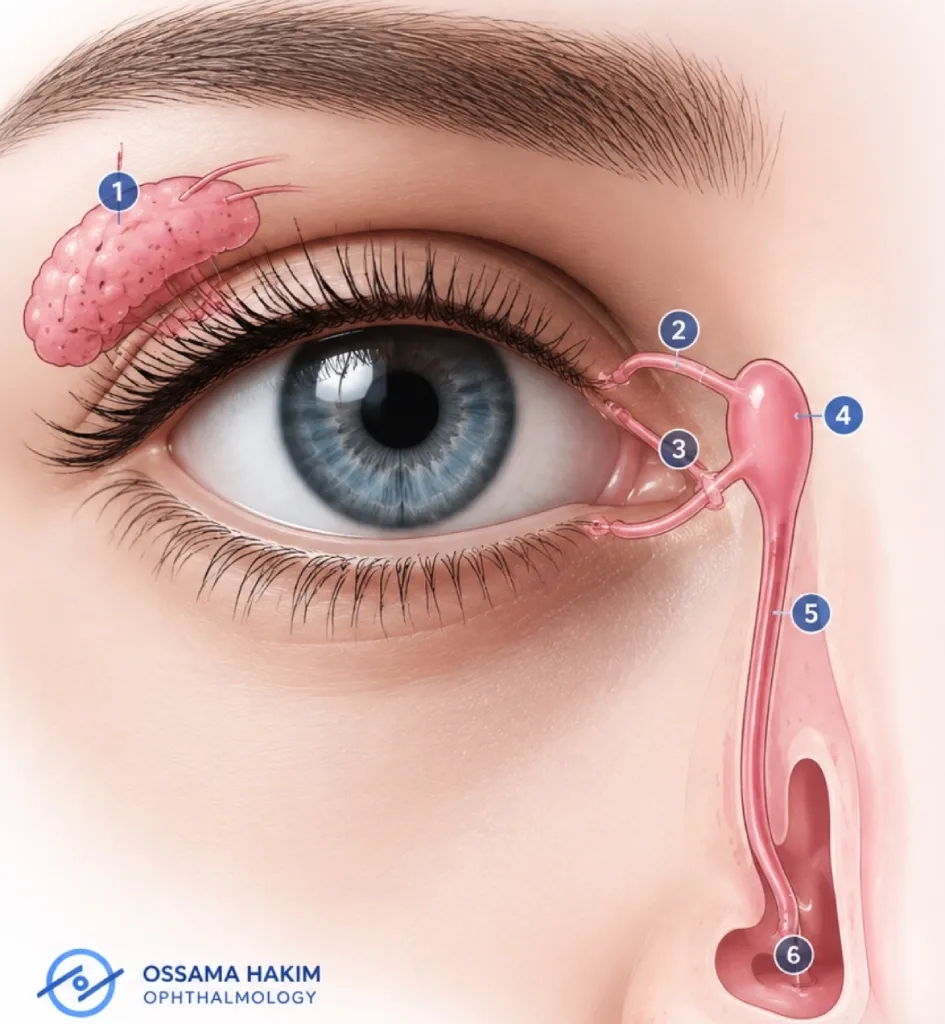
Tears are produced by special glands around the eyes to wash, moisten, and maintain eye health. Normally, they are drained through a precise system that begins at the eyelids and ends in the nasal cavity.

  1. Tears drain through two small openings called the lacrimal puncta, located at the inner corner of both the upper and lower eyelids.
  2. Through delicate tubes called canaliculi, the lacrimal puncta are connected to the lacrimal sac.
  3. The lacrimal sac is located at the inner corner of the eye beside the nose, and tears are drained through a bony channel called the nasolacrimal duct into the nasal cavity.

Causes of excessive tearing (epiphora).

Narrowing of the lacrimal puncta.

This narrowing impedes tear drainage and causes accumulation on the ocular surface.

Dr. Osama Abdel Hakim treats such cases with corticosteroid injections inside the eyelid near the puncta, performed in the clinic under local anesthesia with a high success rate, especially when diagnosed early.

Nasolacrimal duct obstruction.

This obstruction prevents normal tear drainage, and treatment varies according to the patient's age.

Young children.

The obstruction may resolve spontaneously, but some children require a minor surgical procedure in which Dr. Osama performs lacrimal duct probing with a specialized instrument in the operating room under general anesthesia, using nasal endoscopy to ensure success.

Adults.

The obstruction is assessed by injecting saline through the lacrimal passage in the clinic; if the system is patent, the patient tastes the solution in the throat, but absence of taste indicates obstruction.
Dr. Osama treats these cases with dacryocystorhinostomy (DCR), creating a new bony channel in the nasal bone for tear drainage through a small skin incision beside the eye that fades within a month or two with minimal scarring, under general anesthesia.

Our Services

Comprehensive examination.

Accurate diagnosis with modern equipment to identify the root cause of excessive tearing and determine the most appropriate treatment plan.

Non-surgical treatment.

Lubricating drops, warm compresses, corticosteroid injections, and specialized laser treatments for inflammation and glandular obstruction.

Precise endoscopic surgery.

Probing of the nasolacrimal duct under endoscopic guidance for children, and dacryocystorhinostomy (DCR) for adults with minimally invasive techniques and effective results.

It is normal for eyes to tear occasionally due to sadness or dust exposure, but if tearing persists, early diagnosis and treatment are essential. At Dr. Osama Abdel Hakim's clinic, we strive to provide the best service for treating excessive tear production.

Specialists in Eye Health – Dr. Osama Abdel Hakim Clinic.


In the video, Dr. Osama Abdel Hakim explains the lacrimal system and the causes of its obstruction in children.

 In this video, Dr. Osama Abdel Hakim explains endoscopic tear duct probing in children.

In the next video, Dr. Osama Abdel Hakim explains tear duct probing in adults.

احجز كشفك الآن

تابعنا على منصات التواصل