

Treatment of esotropia (inward strabismus).
Esotropia occurs when one or both eyes turn inward toward the nose.
Dr. Ossama Abdel Hakim
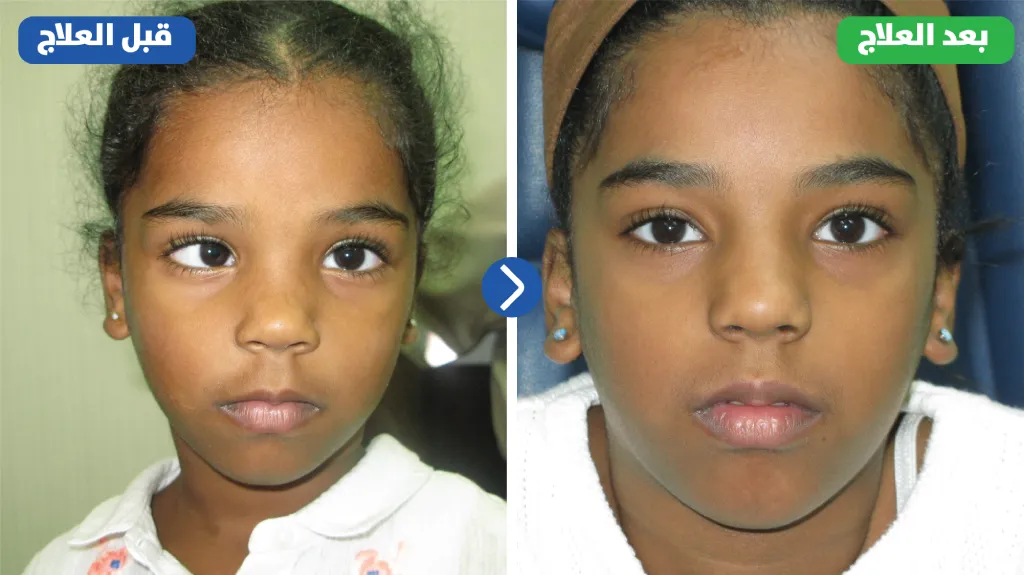
Esotropia (inward strabismus).
It is one of the most common types of strabismus, especially in children, where the affected eye turns inward toward the nose instead of looking straight ahead.Esotropia can be constant (present all the time) or intermittent (appearing and disappearing from time to time). Early treatment is essential to prevent complications such as amblyopia and loss of stereoscopic vision, and early intervention yields the best results in restoring natural ocular alignment.
Symptoms of esotropia.
Inward deviation of the eye.
Noticeable inward deviation of one or both eyes toward the nose.
Diplopia (double vision).
Seeing two separate images of a single object, especially when viewing near objects.
Photophobia (light sensitivity).
Closing one eye in bright light or during concentration.
Loss of depth perception.
Difficulty in correctly estimating distances and dimensions.
Difficulty reading.
Difficulty with reading and focusing on texts.
Head tilting.
The child may tilt or rotate their head to improve vision.
Recurrent headaches.
Recurrent headaches caused by strain of the muscles around the eye.
Eye strain.
A feeling of fatigue and pain in the eyes after prolonged reading or concentration.
Causes of esotropia.
Genetic factors and a family history of strabismus.
High hyperopia (farsightedness) that requires significant effort to focus.
Premature birth or low birth weight.
Weakness or imbalance of the extraocular muscles.
Certain health conditions such as Down syndrome or cerebral palsy.
Certain health conditions such as Down syndrome or cerebral palsy.
Why should esotropia be treated?
To prevent amblyopia (lazy eye) and preserve visual acuity.
To restore normal stereoscopic (three-dimensional) vision.
To improve cosmetic appearance and restore self-confidence.
To enhance the ability to accurately judge distances and depth.
To improve academic performance and the ability to read and write.
To avoid the psychological and social complications associated with strabismus.
Available treatment options.
Corrective prescription glasses.
The use of customized prescription glasses to correct accompanying hyperopia or myopia in esotropia, which is usually the first step in most cases.
Patching of the healthy eye.
Application of a patching program for the healthy eye to strengthen the weak eye and prevent amblyopia.
Botulinum toxin injections.
The use of botulinum toxin injections in specific eye muscles as a temporary or adjunctive alternative to surgery in select cases.
Corrective surgery.
A precise surgical procedure to readjust the eye muscles and achieve the required balance, and it is the definitive solution for moderate to severe cases.